The Fed’s Exercise In Absurdity
 By
Avi Gilburt
By
Avi Gilburt
Our latest article on bank safety: "The Fed’s Exercise In Absurdity"
The Fed has recently announced the results of its annual stress tests. As the chart below shows, the aggregate maximum decline in the CET1 capital ratio under the regulator's severely adverse scenario was the lowest among the past seven stress tests.
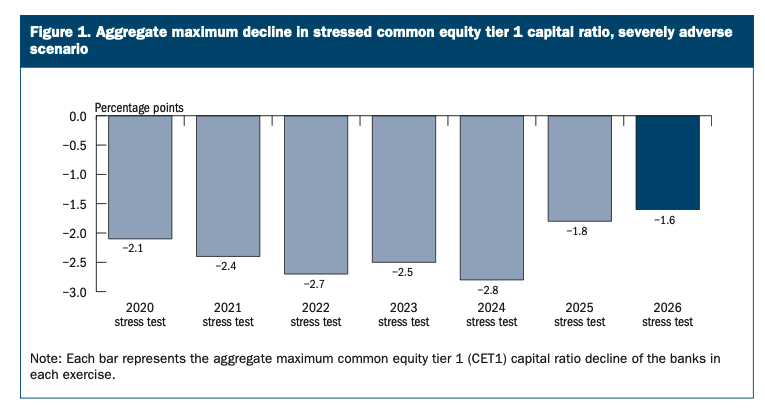
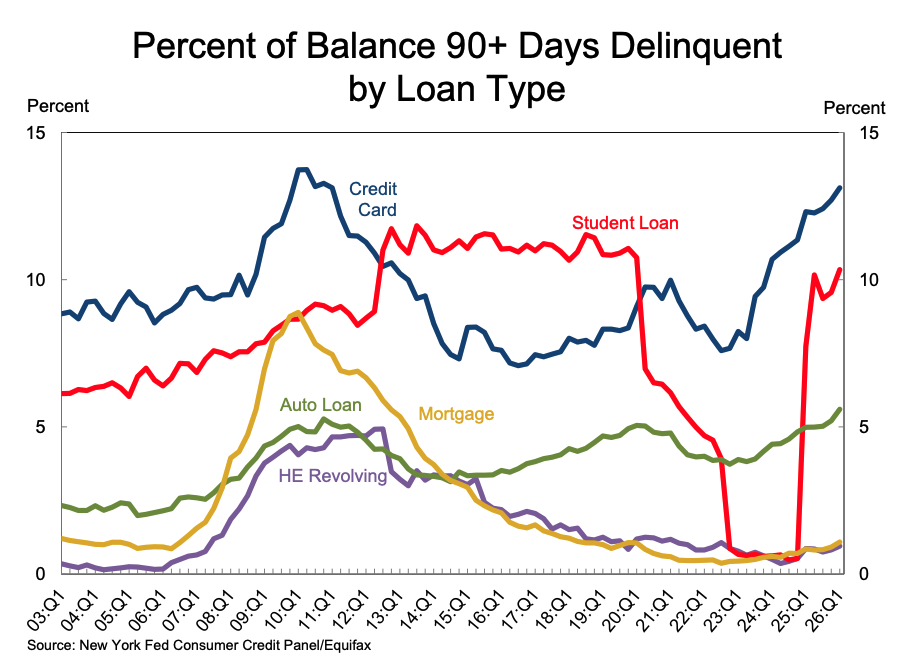
For those following current trends in the US banking industry, this came as a surprise, as asset quality is deteriorating across many credit segments, and in some of them the delinquency ratio is already higher than its GFC peak. Needless to say, this suggests their conclusions are absurd.
We have written several articles explaining why stress tests are a futile exercise. Under its scenarios, the Fed expects a very short-lived V-shaped recession, which says little about banks' resilience to a prolonged downturn. In addition, in previous years some banks said that their own models showed larger losses than the Fed's stress tests, which further undermined their credibility.
One of the weakest points of the Fed's stress test is its assumptions on loan losses.
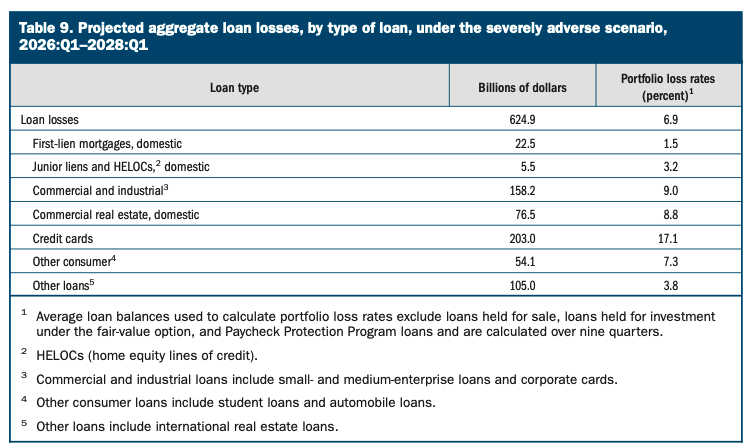
The Fed expects an 8.8% loss rate for CRE, which looks extremely optimistic. A study by researchers from USC, Columbia, Stanford, and Northwestern found that about 43% of all CRE loans and roughly 63–64% of office loans may face cash-flow or refinancing challenges. As a result, the researchers concluded that the banking industry could face CRE default rates in the 10% to 20% range, levels comparable to or even higher than those seen during the Great Recession. Yet the Fed projects only an 8.8% portfolio loss rate for CRE loans under its severely adverse scenario.
Assumptions for other segments also look very optimistic, especially given the current level of delinquencies. Importantly, these near-GFC peaks in delinquencies have occurred in a relatively benign economic environment, before the credit cycle has become stressed.
If you follow our banking work, you know that the Fed ignores a lot of things, which our methodology incorporates. We will not discuss all of them in this article, but will simply name the most important ones.
First, the annual stress test does not meaningfully model rapid deposit-run dynamics or liquidity stress. Even third-party providers, such as Florida Atlantic University, maintain lists of banks that are at significant risk because they can cover only a small portion of deposits with their liquid assets. Deposit runs could lead to the bankruptcy of a bank even with a good capital position.
Second, the Fed does not address shadow lending, which many global regulators describe as the biggest risk to global financial stability. In a recent data publication highlighted by the Financial Times, lending to shadow lenders appears to have accounted for essentially all US bank-lending growth in 2025.
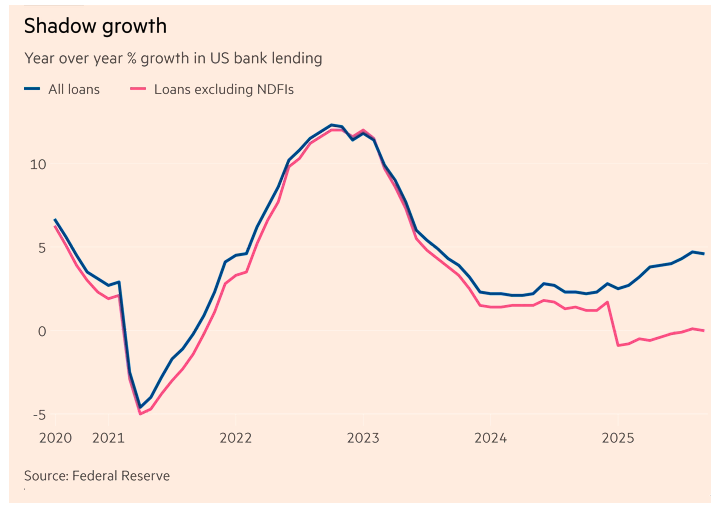
According to a recent NY Fed report, about fifty US bank holding companies had total credit exposure to shadow banks - on-balance-sheet loans plus undrawn commitments -exceeding 100% of Tier 1 equity capital; the most exposed banks reached four to six times that amount. Many were larger banks with more than $10B in assets. Yet this major issue was ignored by the Fed.
Finally, the Fed continues to focus only on a deflationary recession with rates falling. But what will happen if the next crisis is accompanied by rising rates? What if banks face not only credit losses but funding stress as well? And what will happen to the massive amounts of securities that banks bought when rates were low? As a reminder, BAC now reports $84B of unrealized losses from its securities book.
Of course, the Fed will likely never publish such a scenario because the results would likely be much more severe and could reveal much weaker economic capital positions, including at some of the largest banks. At the end of the day, the real-world scenarios look significantly worse than the Fed’s unrealistic “stress-test.”
Bottom line
Believe it or not, there are more major issues on the larger bank balance sheets as compared to smaller banks, which we have covered in past articles. Moreover, consider that there was one major issue which caused the GFC back in 2008, whereas today, we currently have many more large issues on bank balance sheets. These risk factors include major issues in commercial real estate, rising risks in consumer debt (approaching 2007 levels), underwater long-term securities, over-the-counter derivatives, high-risk shadow banking (the lending for which has exploded), and elevated default risk in commercial and industrial (C&I) lending. So, in our opinion, the current banking environment presents even greater risks than what we have seen during the 2008 GFC.
Almost all the banks that we have recommended to our clients are community banks, which do not have any of the issues we have been outlining over the last several years. Of course, we're not saying that all community banks are good. There are a lot of small community banks that are much weaker than larger banks. That’s why it's absolutely imperative to engage in a thorough due diligence to find a safer bank for your hard-earned money. And what we have found is that there are still some very solid and safe community banks with conservative business models.
So, I want to take this opportunity to remind you that we have reviewed many larger banks in our public articles. But I must warn you: The substance of that analysis is not looking too good for the future of the larger banks in the United States, and you can read about them in the prior articles we have written.
Moreover, if you believe that the banking issues have been addressed, I think that New York Community Bank is reminding us that we have likely only seen the tip of the iceberg. We were also able to identify the exact reasons in a public article which caused SVB to fail. And I can assure you that they have not been resolved. It's now only a matter of time before the rest of the market begins to take notice. By then, it will likely be too late for many bank deposit holders.
At the end of the day, we're speaking of protecting your hard-earned money. Therefore, it behooves you to engage in due diligence regarding the banks which currently house your money.
You have a responsibility to yourself and your family to make sure your money resides in only the safest of institutions. And if you're relying on the FDIC, I suggest you read our prior articles, which outline why such reliance will not be as prudent as you may believe in the coming years, with one of the main reasons being the banking industry’s desired move towards bail-ins. (And, if you do not know what a bail-in is, I suggest you read our prior articles.)
It's time for you to do a deep dive on the banks that house your hard-earned money in order to determine whether your bank is truly solid or not. You can feel free to review our due diligence methodology here.