Commercial Real Estate Is Not Getting Any Better
 By
Avi Gilburt
By
Avi Gilburt
In our previous article, we noted that the recently published FDIC risk report revealed several interesting findings. The first one we discussed was the extreme growth in shadow bank lending.
In this article, we would like to discuss the FDIC’s takeaways on current conditions in commercial real estate. We have discussed this topic extensively in our previous articles, but it is still interesting to look at the FDIC’s latest take.
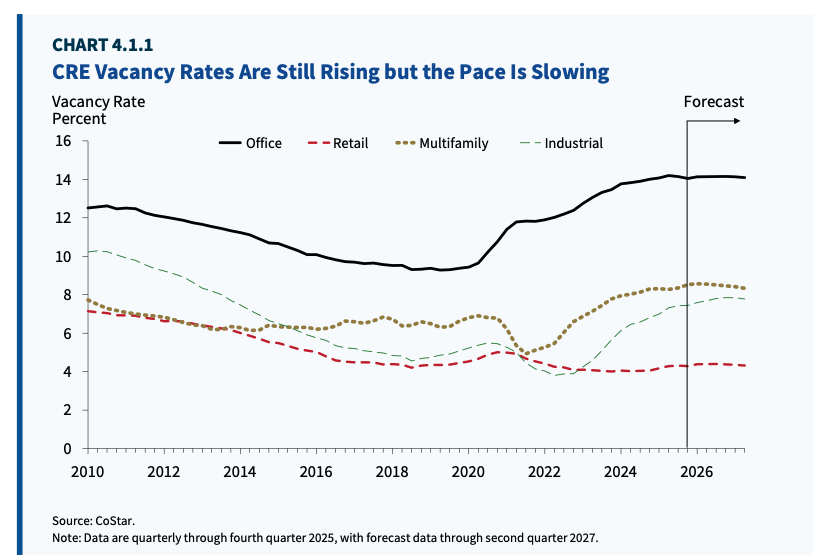
First, according to the FDIC, vacancy rates continued to increase, albeit at a slower pace, across most major property types. Office vacancy rates remained the highest among the four major property types and reached 14.0% at YE25. Multifamily and industrial property vacancy rates also rose, but at a slower pace than the year before, while retail vacancy rates increased for the first time since 2020.
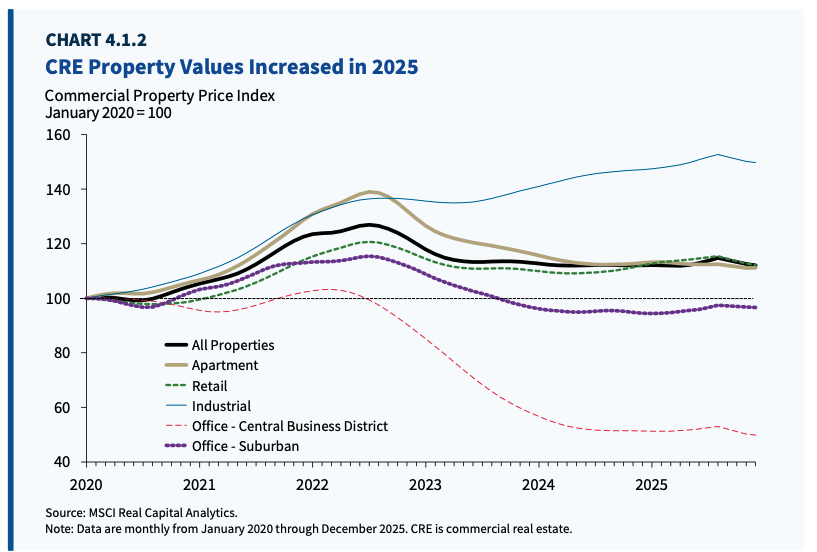
Second, the FDIC said that despite the challenging environment, CRE property values improved slightly in 2025. CRE values ticked up across most sectors, with retail and industrial posting solid gains, while the improvement in office and multifamily properties was more muted.
Third, rent growth remained positive but slowed across all major property types. Net operating income growth also slowed due to higher vacancy and slower rent growth. As a result, the FDIC is saying that the net operating income and debt service capacity of some properties may be challenged by the increase in borrowing costs in recent years, which basically implies that the CRE crisis is yet to come.
Despite all of this, the FDIC is somewhat positive on the segment, given that charge-off and past-due ratios remain historically low, although there was an increase in past-due loans at larger banks.
However, we believe the current past-due and charge-off ratios are artificially low due to the so-called pretend-and-extend strategy that banks have implemented and that we also discussed earlier. As such, we believe the current asset quality indicators do not reflect the actual picture in the CRE space. Importantly, there is an instrument that shows the real asset quality issues in the segment.
We are referring to CMBS (commercial mortgage-backed securities). CMBS delinquencies continue to increase, reflecting weakness in office and multifamily properties. The overall delinquency rate for CMBS loans increased to 7.30% in December 2025, up from 6.57% at YE2024. CMBS loans for multifamily properties experienced the largest increase in delinquency rates among property types and reached 6.64% in December 2025, up from 4.58% the year before. CMBS office loan delinquency rates rose to 11.3%, up from 11.0% the year before, and remained above the prior-cycle peak reached in 2012.
In other words, CMBS is already recognizing the CRE credit cycle, while banks are still managing and delaying it. That said, banks will most likely eventually have to reflect the much higher delinquency ratios shown by CMBS. This could put significant pressure not only on their earnings but also on their capital, as many banks have enormous CRE exposure compared with their capital.
Bottom line
Believe it or not, there are more major issues on the larger bank balance sheets as compared to smaller banks, which we have covered in past articles. Moreover, consider that there was one major issue which caused the GFC back in 2008, whereas today, we currently have many more large issues on bank balance sheets. These risk factors include major issues in commercial real estate, rising risks in consumer debt (approaching 2007 levels), underwater long-term securities, over-the-counter derivatives, high-risk shadow banking (the lending for which has exploded), and elevated default risk in commercial and industrial (C&I) lending. So, in our opinion, the current banking environment presents even greater risks than what we have seen during the 2008 GFC.
Almost all the banks that we have recommended to our clients are community banks, which do not have any of the issues we have been outlining over the last several years. Of course, we're not saying that all community banks are good. There are a lot of small community banks that are much weaker than larger banks. That’s why it's absolutely imperative to engage in a thorough due diligence to find a safer bank for your hard-earned money. And what we have found is that there are still some very solid and safe community banks with conservative business models.
So, I want to take this opportunity to remind you that we have reviewed many larger banks in our public articles. But I must warn you: The substance of that analysis is not looking too good for the future of the larger banks in the United States, and you can read about them in the prior articles we have written.
Moreover, if you believe that the banking issues have been addressed, I think that New York Community Bank is reminding us that we have likely only seen the tip of the iceberg. We were also able to identify the exact reasons in a public article which caused SVB to fail. And I can assure you that they have not been resolved. It's now only a matter of time before the rest of the market begins to take notice. By then, it will likely be too late for many bank deposit holders.
At the end of the day, we're speaking of protecting your hard-earned money. Therefore, it behooves you to engage in due diligence regarding the banks which currently house your money.
You have a responsibility to yourself and your family to make sure your money resides in only the safest of institutions. And if you're relying on the FDIC, I suggest you read our prior articles, which outline why such reliance will not be as prudent as you may believe in the coming years, with one of the main reasons being the banking industry’s desired move towards bail-ins. (And, if you do not know what a bail-in is, I suggest you read our prior articles.)
It's time for you to do a deep dive on the banks that house your hard-earned money in order to determine whether your bank is truly solid or not. You can feel free to review our due diligence methodology here.